
SEO has changed a lot over the past few years:
- Google is using AI more heavily.
- Search results are more dynamic.
- People are asking longer, more conversational questions.
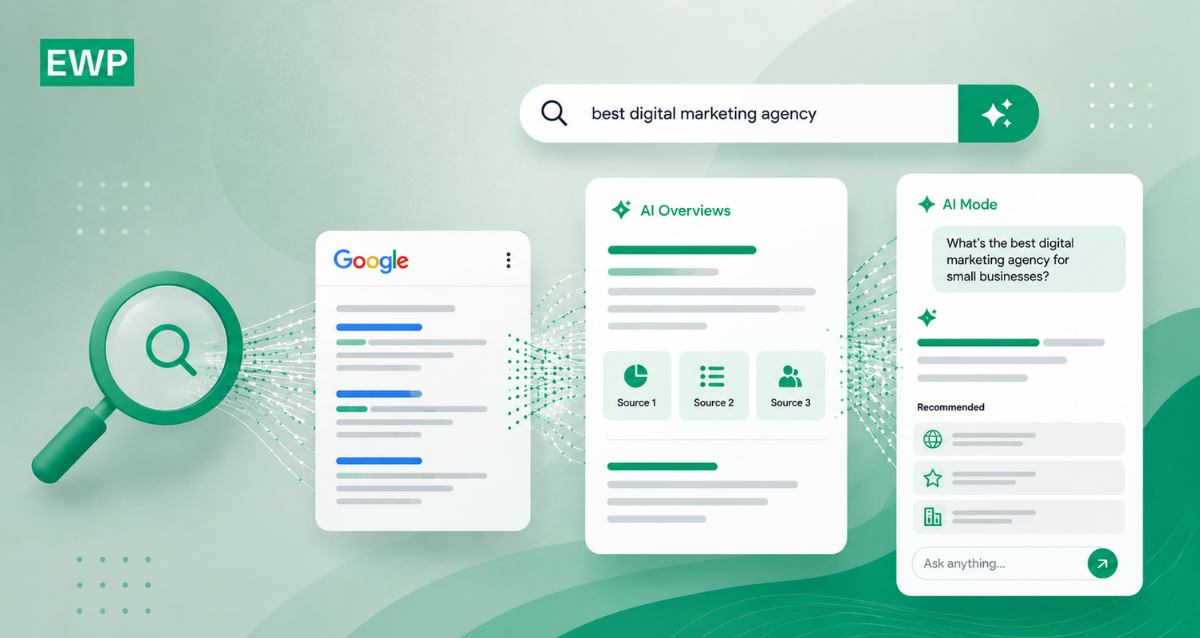
- AI Overviews and AI Mode are changing how users discover information.
At the same time, the fundamentals have not disappeared. You don’t need to throw your previous SEO strategy away and start chasing every new acronym.
In fact, Google’s own guidance on AI search makes it clear that the SEO fundamentals still apply to AI-powered search experiences.
What has changed is the standard. A website now needs to be useful, technically sound, trustworthy and genuinely worth finding.
Here is what that means in practice.
1. AI has changed search, but it has not killed SEO
You do not need to create a special version of your website for AI.
The biggest change in SEO in 2026 is obvious: search is becoming increasingly AI-driven.
Google’s AI Overviews and AI Mode can answer questions directly, combine information from multiple searches and surface links to relevant websites.
That has led to a new wave of terminology: AEO, GEO, AI SEO, LLM optimisation and so on.
Some of it is useful, but a lot of it is just marketing.
Google does not tell website owners to implement some completely separate form of “AI SEO”. Instead, it recommends focusing on the same fundamentals that make content useful and accessible in traditional search.
That means you do not need to create a special version of your website for AI.
You need to create a better website.
2. Generic content is becoming less useful
For years, a common SEO strategy was to find a keyword, look at what already ranks and create something slightly longer. That approach is becoming increasingly difficult to justify.
Google’s guidance on creating helpful, people-first content specifically encourages original information, analysis, first-hand expertise and content that provides substantial value beyond what is already available.
What does useful content look like?
It could be:
- Your own experience working with a particular type of customer
- Original research or data
- A detailed comparison based on real testing
- Examples from actual projects
- Expert analysis of a problem
- Clear answers to questions customers regularly ask
- Practical information that goes beyond the obvious
The important part is that there is a reason for your page to exist.
If ten websites already provide essentially the same information, there is little reason for an eleventh page to exist. If an AI could produce the same article from five other websites in a few seconds, you need to ask what your version adds.
3. AI-generated content is not automatically bad
There is also an important distinction here:
Using AI to help with research, brainstorming, outlining, editing or content production is not inherently an SEO problem. The problem is publishing large amounts of generic content simply because you think more pages will generate more traffic.
As Google explains in its guidance on using generative AI content, AI can be useful for research and structuring original content. But generating large numbers of pages without adding value can fall foul of Google’s spam policies.
Our recommendation is straightforward: Use AI where it makes the work better or more efficient. Then add the part AI cannot provide on its own, such as actual expertise, experience, judgement and a reason for someone to trust what you are saying.
That is particularly important for businesses. A page written by someone who actually knows the industry will usually be more useful than another perfectly structured AI article that says exactly what 50 other websites say.
4. Technical SEO still matters
The technical SEO work you were doing before AI search is still just as relevant.
The shift towards AI search has not made technical SEO irrelevant.
Quite the opposite.
Before Google can understand your content, it needs to be able to access, crawl and index it.
That means the basics still matter:
- Your important pages need to be indexable
- Internal links should make your site easy to navigate
- Important content should be available as text
- Your site should work properly on mobile
- JavaScript should not prevent important content from being accessed
- Duplicate and unnecessary URLs should be controlled
- Structured data should accurately reflect the visible content
- Your sitemap and canonical signals should make sense
Google’s current AI search guidance specifically says that pages need to meet the normal technical requirements for Google Search, with no additional technical requirements for appearing in AI Overviews or AI Mode.
In other words, the technical SEO work you were doing before AI search is still just as relevant.
This is where we often see a disconnect: A business can spend thousands on content while having a website that is slow, difficult to crawl or poorly structured. More content will not fix that. It all comes down to the tech.
5. Website performance is still part of the equation
Here’s the truth: Speed is not a magic ranking button. Making a website faster does not automatically send it to position one.
But performance still matters for one important reason: it affects the experience people have when they visit your site, and Google continues to recommend a good page experience.
Core Web Vitals measure real-world loading performance, responsiveness and visual stability. The current Core Web Vitals are:
- LCP: how quickly the main content loads
- INP: how responsive the page is to interaction
- CLS: how stable the page layout is while loading
For a good user experience, the recommended targets are an LCP of 2.5 seconds or less, an INP of 200 milliseconds or less and a CLS of 0.1 or less at the 75th percentile. You can see the current thresholds in Google’s Core Web Vitals documentation.
But the bigger point is simple: If your website takes five seconds to become usable on a mobile connection, you have a website problem. Then it won’t matter whether an SEO tool gives your content a green score.
6. Search intent matters more than exact-match keywords
Google has become much better at understanding what people mean.
This means that you do not need to repeat the exact keyword 15 times because you think Google needs reminding what the page is about. Instead, think about the actual reason someone searched.
For example, someone searching for “website redesign” might be looking for:
- Signs that their website needs replacing
- The cost of a redesign
- How long a redesign takes
- Whether a redesign will affect SEO
- Examples of modern websites
- A company to carry out the work
Those are very different intents.
A good SEO strategy identifies them and decides which questions deserve their own pages and which belong together.
Google’s Search Essentials (formerly Webmaster Guidelines) also recommends using the words people would use to look for your content, while focusing on useful content rather than producing pages simply to target every possible variation of a keyword.
7. Your website needs to demonstrate who is behind it
Trust matters.
This is particularly important for businesses competing in crowded markets.
Google’s guidance encourages clear information about who created the content, including author backgrounds and evidence of genuine expertise. It also discusses experience, expertise, authoritativeness and trustworthiness (EEAT) as important concepts when assessing content quality.
For a business website, that can mean:
- Real information about your company
- Clear contact details
- Proper author information where appropriate
- Evidence of experience
- Case studies and examples
- Reviews and testimonials
- Accurate service information
- Original photography where it adds value
- Clear explanations of what you actually do
You do not need to plaster “E-E-A-T” across your website. You just need to give people reasons to trust you.
8. Local SEO is still very important
For businesses serving a particular area, local visibility remains one of the most practical areas of SEO.
That means getting the basics right:
- Google Business Profile
- Consistent business information
- Location-specific service pages where genuinely useful
- Reviews
- Relevant local links and mentions
- Clear information about where you operate
- Useful local content
This is becoming even more interesting as AI-powered search starts combining local information with broader questions.
Google’s latest guidance for AI search specifically discusses keeping business information up to date, including Business Profile information, as part of the fundamentals for visibility in AI search experiences.
For a local business, being understood as a real business in a real location is more useful than publishing 100 generic blog posts.
9. Links still matter, but quality trumps quantity
Backlinks are not dead. Neither is link building.
But what has changed is the value of low-quality links. A large collection of unrelated directory links, paid guest posts and artificial placements is not a sustainable SEO strategy.
A genuinely useful link is still useful because it represents a relationship between websites. If a respected industry publication references your company, a relevant partner recommends your service, or an organisation cites your research, that makes sense.
The goal should not be “How many backlinks can we build this month?”
It should be:
Why would another website want to reference us?
That question leads to much better SEO.
10. Stop measuring SEO purely by rankings
Rankings are useful, but they are not the final objective.
A business does not need to rank first for everything. It needs to attract the right people and, most importantly, turn that visibility into something valuable.
That could mean:
- More enquiries
- More calls
- More bookings
- More sales
- More qualified traffic
- More people discovering the brand
- More visibility for important services
This is particularly important as search becomes less predictable.
A page can appear in a traditional search result, an AI-generated result, a local result, an image result or several of these at once.
Google has even started rolling out dedicated generative AI performance reporting in Search Console, giving some sites visibility into impressions from features such as AI Overviews and AI Mode.
The key takeaway is to look at the whole picture.
Rankings are useful, but they are not the final objective.
So, what should businesses actually do in 2026?
If your website has been neglected, you do not need an enormous AI SEO strategy. Simply start with the fundamentals.
1. Fix the website
Make sure it is fast, mobile-friendly, technically accessible and easy to navigate. Or have us do it; see our website services.
2. Review your existing content
Find pages that are outdated, thin, duplicated or no longer useful. Improve them where there is something worth saving. Remove what does not deserve to exist.
3. Create content with a reason
Do not publish an article because a keyword tool says you should; publish it because your customers need the information. See how we can help with content.
4. Add genuine expertise
Show people why they should listen to you. Use experience, examples, opinions and original information.
5. Build authority naturally
Get your business mentioned in places where your customers and industry actually spend time.
6. Measure business results
Look beyond rankings and traffic. Track the actions that actually matter to your business.
The fundamentals have not changed – the bar has
SEO in 2026 is not about finding a new trick that Google has not caught up with yet.
It is about building a website that deserves to be visible, thanks to:
- Useful content
- Good performance
- Clear information
- A strong user experience
- Genuine expertise
- And a business that gives people a reason to choose it
AI has changed how people search, but it has not changed why good websites succeed.
The businesses that take SEO seriously in 2026 will not be the ones chasing every new SEO acronym. They will be the ones building useful websites, publishing things worth reading and making it easy for both people and search engines to understand what they do.
That is the approach we take at Easy Web Partner.