
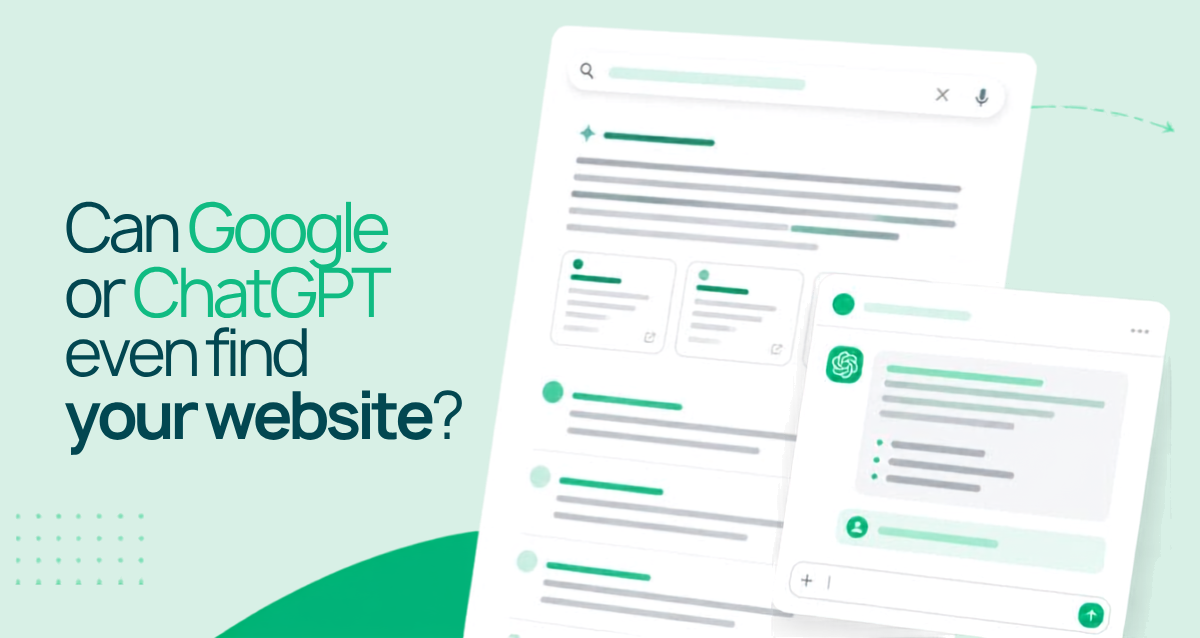
Your website might be online and look good, but is it actually bringing your business any value and leads?
It is easy to assume that once your website is live, people can find it. But unfortunately, it isn’t quite that easy. Especially not if you are looking for organic results from Google, ChatGPT and other AI-powered search tools.
That’s because search engines and AI tools need to be able to access your website, process its content and understand what your business is about. If something gets in the way of any of that, your website might as well not exist.
In this blog post, we look at the basics of how websites get found online and what can stop your website from appearing in relevant searches.
Your browser can see your website, but can Google?
If you have created a website using an AI tool or a simple website builder, you might have spent a lot of time tinkering with how it looks before finally publishing the result.
We get it. First impressions are crucial, and you want your business to look its best.
The problem is that a pretty surface isn’t enough. Everything also needs to work under the hood.
Put simply, search engines don’t experience a website in the same way you do. They use automated systems to discover, process and understand websites, and there are several steps between putting a website online and it appearing in search results.
Three important technical factors are:
- Crawling: Search engines can access and discover your pages.
- Rendering: Search engines can process the page and its content.
- Indexing: Search engines can include the page in their search index.
If there is a problem at any of these stages, your website may not perform as expected in search.
What happens if your content isn’t easy to crawl?
Crawling is how search engines discover and access the pages on your website.
If they can’t properly access your pages or their content, you can run into problems such as:
- Important pages not being discovered.
- Content not being indexed as expected.
- Changes taking longer to appear in search.
- Search engines having less information about your business.
- AI search tools having less useful information to work with.
There are several things that can interfere with crawling. For example, your website might accidentally block crawlers through your robots.txt file, important pages might not be properly linked, or parts of your website may be difficult for automated systems to access.
This means that even if your website works perfectly when you open it, search engines may not be able to discover everything you want them to find.
What does rendering mean?
Crawling is only the first step.
Once a search engine has discovered a page, it needs to process it and its resources to understand the content that is actually there. This is known as rendering.
Put simply, you need to ensure that the important content on your website can actually be accessed and processed by the systems you want to find you. This is where things get a bit technical.
Server-Side Rendering (SSR) vs. Client-Side Rendering (CSR)
One of the technical decisions that affects how a website delivers its content is where the page is rendered:
- With server-side rendering (SSR), the server prepares the page and sends the content to the browser when the page is requested.
- With client-side rendering (CSR), the browser relies more heavily on JavaScript to build or load the page after the initial response.
The problem comes when important content is only available after additional processing, and that process doesn’t work as expected for a crawler.
For example, JavaScript can add another dependency between a crawler discovering your page and being able to process all of its content correctly. And in fact, some bots can’t render JavaScript at all.
This is worth paying attention to when using website builders, AI website tools or building a website through “vibe coding”. The technology behind these tools can rely heavily on client-side rendering – potentially making your website harder for Google and AI to read.
This is one reason why the technical foundation of a website truly matters.
Is your website actually indexable?
Being accessible doesn’t automatically mean a page can appear in Google.
Your website can contain instructions that tell search engines not to index certain pages. A classic example is a “noindex” tag accidentally left in place when a website moves from development to production.
Pages can also run into indexing problems if they return server errors, require a login or are incorrectly redirected when they should be accessible as separate pages.
Unless you know what to look for, these issues can easily sit in the background without you realising.
Being indexed doesn’t mean you’ll be found
Even if all of the technical requirements are in place, you can still get very little traffic from search.
Why?
Because being included in Google’s index is not the same as ranking for the searches your potential customers are making. This is where search engine optimisation (SEO) comes in.
If your website isn’t getting the results you want, it could be because it has:
- Generic text that could describe almost any business.
- No clear keywords or search terms.
- Several pages competing for the same topic.
- Duplicate or very similar content.
- Important services bundled together.
- Content that doesn’t match what potential customers are actually searching for.
SEO is about more than keywords. It also involves making sure your website is technically accessible, clearly structured and useful for the people searching for what you offer.
In short, technical foundations and good content need to work together.
What about ChatGPT and AI search specifically?
Appearing in search is no longer just about Google. Today, you also want your business to have the potential to appear in relevant AI-generated answers.
The good news is that you don’t need a completely separate system to optimise for AI search. The same basic principles still apply: AI systems need access to information, and they need to be able to understand it.
But different AI services have different crawlers, rules and ways of discovering information.
For example, OpenAI uses a crawler called OAI-SearchBot for ChatGPT search. If you want your public website to be available to ChatGPT search, your site needs to allow the relevant crawler to access it.
And again, being crawlable is only the starting point.
Checklist: Can Google and AI actually find your website?
In summary, to make sure your website can actually benefit from organic search, there are many things that need to be in place:
- Crawlability: Can search engines and relevant AI crawlers access your important pages?
- Rendering: Can they process the content on those pages?
- Indexability: Are your pages technically eligible to be indexed?
- Content: Does each page clearly explain what you offer?
- Keywords: Are you using the words and phrases your customers actually search for?
- Structure: Are your services and topics organised into useful, focused pages?
- Uniqueness: Does your content offer something specific to your business rather than generic copy?
- Search intent: Does your content actually answer what people are looking for?
A website can look great at first glance but have problems behind the scenes. And without the right technical knowledge, these issues can easily go unnoticed.
There is no shortcut around having a well-built website with useful, relevant content. The technical side and the content need to work together if you want your website to generate visibility and opportunities for your business.
That is why we combine our expertise in tech and content to deliver modern websites that actually benefit your business.